


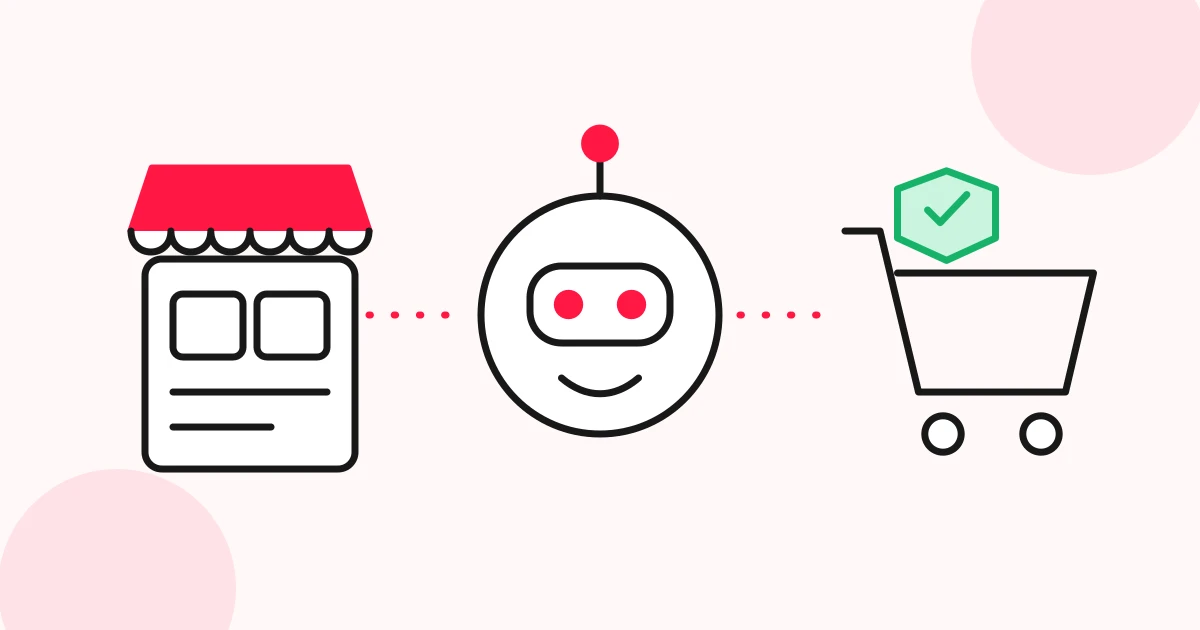
Agentic commerce is commerce in which an AI agent acts on behalf of a person or a business: it searches for products, compares offers, builds the cart and, within the limits it was given, completes the purchase and tracks the delivery. The store stays the same. What changes is who browses it: instead of a person clicking on a screen, a piece of software that reads data, calls APIs and asks for permission when it needs to.
This guide is written for two readers at once: the people who run the business and need to decide whether the topic deserves attention now, and the e-commerce or platform team that will make it work. You will not find market forecasts or adoption figures here. The focus is on what the protocols themselves document and what a store can check today.
What is agentic commerce, in a nutshell?
It is selling to a customer who arrives through an agent. The agent receives an intent, such as “find running shoes under R$400, size 42, delivered by Friday”, and turns that request into searches, comparisons and actions. At the end, it returns a choice ready for the person to confirm or, when it has permission, a purchase already made.
That is where the word “agentic” comes from: the system does not just answer, it acts. A chatbot that recommends products and sends a link is still traditional commerce. An agent that checks stock, calculates shipping, creates the order and starts the payment is already doing agentic commerce.
How is agentic commerce different from traditional e-commerce?
In traditional e-commerce, everything was designed for eyes and clicks: storefront, banners, filters, a buy button and a checkout form. The person interprets the page and decides. In agentic commerce, the first reader of the store is a machine, and that changes what makes a store work well.
| Aspect | Traditional e-commerce | Agentic commerce |
|---|---|---|
| Who browses | A person, on a screen | An AI agent, on behalf of a person or business |
| How the offer is read | Layout, photos and copy | Structured data, feeds and APIs |
| How the purchase happens | Clicks through the cart and checkout | API or protocol calls, with clear states |
| How payment is authorized | The person chooses and confirms the payment method | The person’s confirmation, or prior authorization limited by amount, store and time |
| What blocks the sale | Slow pages, confusing forms | Captchas, bot blocking, prices only in images, a checkout that requires a human click |
The agent does not replace the store. Catalog, pricing, stock, shipping, fraud prevention, payments and customer service stay with the merchant. The best-known protocols say so explicitly: both the Agentic Commerce Protocol (opens in a new tab ↗) and the Universal Commerce Protocol (opens in a new tab ↗) state that the business remains the merchant of record and owns the customer relationship. The agent is a new sales channel, not a new owner of the sale. We go deeper into this in AI agent payments: what changes when checkout is no longer a screen.
How does a purchase made by an AI agent work?
Details vary from channel to channel, but the path usually goes through six steps.
- Intent. The person says what they want and what the limits are: budget, deadline, brand, size.
- Discovery. The agent looks for stores and products by reading what they publish: catalog, prices, stock, shipping and policies.
- Cart. The agent picks items and variants, and the store returns the official total, including shipping, discounts and taxes.
- Authorization. The person confirms the purchase, or the agent uses an authorization given earlier, with clear rules.
- Payment. The payment goes through the store’s own gateway or PSP. The agent carries a token or an authorization, without needing to see the card details.
- After-sales. Order status, tracking, exchanges and returns must be available without anyone copying codes out of an email.
At every step, the store has the final word on price and stock. If the price changed since the search, the agent must receive the new amount before completing, instead of closing the purchase at an old price.
What are the levels of agent autonomy?
Not every agent buys on its own. A practical way to frame the topic is to think in four levels. It is a teaching scale to discuss with your team, not an official standard.
- Researches and recommends. The agent finds options and sends the person to the store. The purchase happens in the usual checkout.
- Prepares the purchase. The agent builds the cart, and the person reviews and confirms before paying.
- Buys with approval. The agent runs the checkout, but the person approves each payment, for example in their banking or wallet app.
- Buys within limits. The agent completes the purchase on its own, within rules set in advance: maximum amount, allowed stores, category and time window. Think of a recurring restock.
The Agent Payments Protocol (AP2) (opens in a new tab ↗) addresses exactly this difference by distinguishing transactions where the person is present from those where they are not present at the moment of purchase. For the store, the consequence is straightforward: the first two levels already depend on a machine-readable catalog; the last two also depend on checkout and payments through an API.
What does a store need to sell to AI agents?
A catalog a machine can read
The agent needs to understand what the store sells without interpreting the page design. That starts with structured product and offer data following schema.org Product (opens in a new tab ↗), with price, availability and variants. It also helps to have the price in the initial HTML, not only after scripts load, plus an up-to-date sitemap or catalog feed. An offer written only inside an image is not a reliable basis for comparison.
Open access for legitimate agents
The robots.txt file says which bots are welcome and where. But, as the specification itself points out (RFC 9309 (opens in a new tab ↗)), these rules are not a form of access authorization: what actually decides is the firewall or the bot management service. Blocking all automated access protects against abuse, but it also shuts out the agent that was coming to buy. The balance lies in telling apart bots that collect data to train models from agents that visit the store at a customer’s request, and in avoiding captchas on the steps an agent needs to complete.
Cart and checkout through an API
To go from storefront to order, the agent needs a stable path: a cart API or predictable URLs, guest checkout where it makes sense, and a checkout session that returns the full, official state of the purchase. You also need to prevent duplicate orders and charges when a call is repeated, a safeguard known as idempotency.
Protocols: MCP, ACP, UCP and AP2
Four acronyms come up in almost every conversation on the topic. They do not compete with each other and do not have to be adopted all at once.
MCP (Model Context Protocol) (opens in a new tab ↗) is an open standard for connecting AI applications to external systems, such as tools and data sources. A store can use it to expose catalog or order lookups to an agent.
ACP (Agentic Commerce Protocol) (opens in a new tab ↗) is an open standard developed by Stripe and OpenAI to coordinate checkout between buyer, agent and business and to share payment credentials securely. According to the protocol’s website, OpenAI is the first AI platform to implement it, in ChatGPT.
UCP (Universal Commerce Protocol) (opens in a new tab ↗) is an open standard co-developed by companies such as Google and Shopify. It covers catalog search, cart, identity linking, checkout and order management, and it is compatible with MCP and AP2.
AP2 (Agent Payments Protocol) (opens in a new tab ↗) focuses on proving that the person authorized the agent, using digitally signed mandates for checkout and for payment. According to the AP2 documentation, standardization continues in FIDO Alliance working groups.
We compare the four in detail in MCP, ACP, UCP, and AP2: what each protocol solves in agentic commerce.
Payments with limited authorization
Delegating a purchase is not handing a card to an AI. What gets delegated is a limited permission: this store, this amount, until this time. Processing stays with the store’s PSP, which applies its own risk and authorization rules. That is why, beyond accepting the channel, the store needs to know which authorization it received and keep a record of who approved what.
In Brazil, Pix is part of this conversation. In everyday Pix payments, the payer confirms the transaction in their own banking app, which fits the levels where the person approves each purchase. For recurring charges, Pix Automático (opens in a new tab ↗) lets the payer authorize a company’s charges once, at their bank. On the protocol side, the AP2 documentation states that the initial version supports methods such as credit and debit cards and that the roadmap includes real-time bank transfers, citing Pix. It is also worth stating on the site, in plain text, which payment methods the store accepts: Pix, card, boleto.
Trackable after-sales
A sale only ends when the order arrives. A tracking page that works without a login, plus structured order and delivery data, lets the agent, or the person who authorized it, follow the purchase without friction.
What are the risks of agentic commerce and how do you control them?
Wrong or out-of-scope purchases. Agents can misread a request or be manipulated by malicious content. The control lies in verifiable limits on amount, store and time, in confirming the final total before completing and, in more advanced flows, in signed mandates such as AP2’s.
Outdated price or stock. The store must be the official source of the cart state and recalculate everything at completion, refusing to complete when something has changed.
Malicious bots. Opening the store to agents does not mean opening it to any automation. Rate limits, identification of verified bots and monitoring are still needed.
Duplicate charges. Repeating a call must not create two orders or two charges. Idempotency keys and clear states solve this.
Disputes and liability. When something goes wrong, the question is who is accountable: the person, the agent’s developer, the store or the payment provider. The AP2 documentation itself lists this as one of the problems to solve. Keeping the authorization trail, with who approved what and when, is the best defense.
Personal data. Share with the agent only what is needed to complete the purchase, following data protection rules such as Brazil’s LGPD.
Where to start: the business and the e-commerce team
For the people who run the business, the first decision is not technical: which channels the brand wants to appear in, which products make sense for agent purchases and which limits the operation accepts, such as maximum amount, categories and return policy.
For the e-commerce or platform team, a safe sequence starts with what already pays off in search and only then moves on to what touches money.
- Publish structured product and offer data, with price and stock in the initial HTML.
- Review robots.txt and firewall rules so legitimate agents are not blocked.
- Provide an order tracking page that works without a login.
- Test whether a cart can be built and read predictably.
- Only then evaluate ACP, UCP or MCP based on the channels where the brand wants to be, with authorization and idempotency from day one.
How can I tell if my store is ready for AI agents?
AZPay Agentic Readiness runs this diagnosis for free. Just enter the store URL: it runs 38 checks across six criteria (catalog, cart, checkout, bot policies, payment and traceability), with a score from 0 to 100 per criterion and a list of what to fix. The diagnosis only reads what the store already publishes: it does not log in, build a cart, place an order or pay.
Frequently asked questions
Is agentic commerce the same as shopping through ChatGPT?
Not exactly. Buying inside an assistant such as ChatGPT is one example of agentic commerce, but the concept is broader: it applies to any agent that buys on someone’s behalf, whether in a chat assistant, an app, by voice or in a company’s procurement.
Do I need to adopt a protocol to get started?
Not necessarily. The foundation comes first: a readable catalog, open access for legitimate agents and a checkout that does not depend on human clicks. The choice of protocol depends on the channels where the brand wants to be and what they support.
Does the agent keep the customer’s card details?
In the documented models, it does not need to. ACP, for example, was designed to pass payment credentials between buyer and business through tokens, without exposing the card details. Processing stays with the store’s payment provider.
Does Pix work in agentic commerce?
Pix can fit into flows where the person confirms the payment in their banking app, and Pix Automático covers recurring charges authorized in advance. For fully autonomous purchases, protocol support for real-time transfers is still evolving: in AP2, for example, it is on the roadmap. Check with your payment provider what is already available.
Who is liable if the agent buys the wrong thing?
There is no single answer yet. It depends on the channel, the contracts and the authorization flow used. That is why the protocols invest in verifiable records of who authorized each purchase, and the store should keep that trail.
Does blocking bots protect my store?
Partly, but blocking everything also turns away agents that would bring sales. The way forward is to separate abuse from an agent acting at a customer’s request, using robots.txt, firewall rules and identification of verified bots.
Sources
- Model Context Protocol — What is MCP (opens in a new tab ↗)
- Agentic Commerce Protocol (opens in a new tab ↗)
- Universal Commerce Protocol (opens in a new tab ↗)
- Agent Payments Protocol (AP2) (opens in a new tab ↗)
- RFC 9309 — Robots Exclusion Protocol (opens in a new tab ↗)
- schema.org — Product (opens in a new tab ↗)
- Banco Central do Brasil — Pix Automático (opens in a new tab ↗)
Sources consulted on November 22, 2026.