


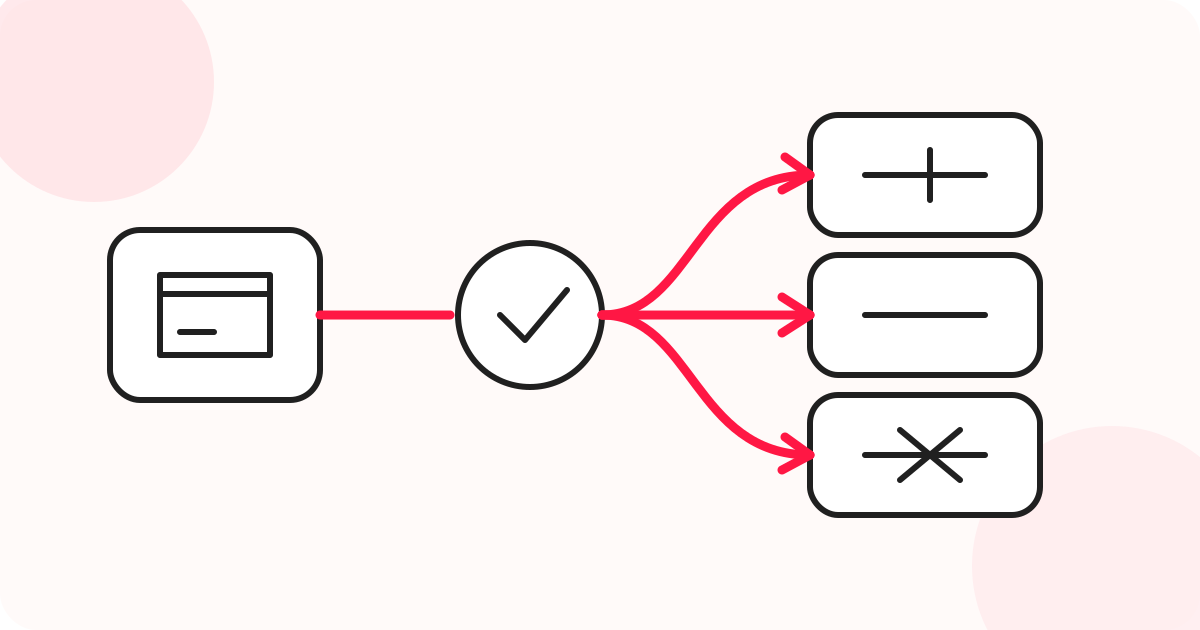
A declined transaction is not a single category. For teams operating payments at scale, there is an important difference between a decline that may be worth retrying, one likely to remain negative until something changes, and a technical failure that should not be interpreted as an issuer decision.
This distinction affects approval rates, customer experience, retries, Smart Routing, fraud prevention, 3DS, observability, and operational cost. When every negative outcome becomes simply “payment declined,” the system loses information precisely when it most needs to decide what to do next.
Soft decline, hard decline, and technical error are useful labels for organizing this problem, but they are not a universal standard with identical semantics across acquirers, issuers, and PSPs. The architecture must treat these concepts as an operational classification based on the received signal, not as an absolute truth contained in an isolated code.
What is a payment decline?
A decline is an outcome in which an attempt was not approved to proceed as a payment under those specific conditions.
For cards, the final authorization decision involves the issuer, but the signal reaching the merchant may pass through a network, acquirer, gateway, PSP, and normalization layers before appearing in the application. The received code may be highly specific, generic, translated, or even replaced by a broader category.
The first step is therefore to separate a financial decision from a technical failure. An explicit issuer response saying the transaction was not approved contains different information from a timeout between systems.
In the first case, there is a known negative decision. In the second, there may simply be an absence of a sufficient response.
Confusing the two often produces dangerous retries, poor metrics, and inaccurate diagnoses.
What is a soft decline?
A soft decline is a classification for potentially recoverable declines: the condition that caused the negative response may change, or an additional action may allow another attempt in a different context.
This does not mean every soft decline should be retried immediately. Nor does it mean a second attempt will be approved.
A decline may be classified as recoverable when, for example, an authentication step is missing, the issuer has a temporary condition, a temporary limitation applies, or the transaction must be resubmitted in a way the ecosystem supports.
The value of this classification lies in allowing the application to respond differently. Instead of displaying a final error, it can request customer action, offer another payment method, perform authentication where applicable, or schedule another attempt in a controlled context.
The most important word in soft decline is potentially.
Recoverable does not mean “retry indefinitely.”
What is a hard decline?
A hard decline is the classification used when a decline indicates a condition unlikely to be resolved simply by repeating the same transaction without any relevant change.
Conceptual examples include permanently invalid credentials, a closed card account, a restriction requiring another payment method, or certain declines related to risk and issuer policy.
The appropriate behavior is usually to stop automatic retries of that same attempt and request a change of context. This may mean another card, another payment method, or customer intervention.
The exact classification varies across processors. The same reason may arrive with different codes depending on the acquirer, network, country, and level of detail the PSP exposes.
A hard decline should therefore be an evidence-based internal category, not a table copied once and treated as a permanent rule.
Is a technical error a decline?
Not necessarily.
A connection error, timeout, outage, format error, integration failure, or internal provider error should not automatically be interpreted as a negative issuer decision.
This difference is critical.
With an explicit decline, the system knows the attempt ended with a known negative result.
With a timeout after the request left your system, the transaction may have been processed and the response lost.
In that situation, immediately repeating the charge through another PSP can create a second authorization or another financial effect.
Technical classification must preserve states such as unknown result, processing, or awaiting reconciliation when the system lacks enough evidence to say “failed.”
Why are decline codes difficult to normalize?
Because the payment ecosystem has several layers, each of which may represent a problem differently.
The issuer may generate a reason. The network may carry a code. The acquirer may map it. The PSP may translate it again. Your platform may then convert all of this into a more stable business taxonomy.
In some flows, the merchant receives a code very close to the one generated during processing. In others, it receives categories such as “do not honor,” “insufficient funds,” “authentication required,” “invalid card,” “suspected fraud,” or simply “declined.”
The purpose of normalization is not to pretend all codes are the same. It is to create a layer that answers important operational questions.
Was this an explicit decline or a technical error? Does the condition appear recoverable? Is customer action required? Is authentication required? Can the transaction be retried safely? Does another route make sense? Should we simply offer another method?
This taxonomy is more useful than an enormous list of codes scattered throughout the product.
Can a soft decline always be retried?
No.
Retrying is a business and infrastructure decision, not an automatic consequence of the soft label.
Another attempt makes sense only when there is reason to believe something changed or the protocol provides for an intermediate action.
If authentication is missing, retrying without authenticating may produce the same decline. During a temporary outage, retrying after an interval may make sense. If the issuer specifies another way to present the transaction, the retry must respect that condition.
Indiscriminate retries increase attempt volume, hurt the experience, may raise costs, and may even look abusive to ecosystem participants.
Retry policy must consider the reason, timing, number of previous attempts, transaction context, payment method, credential type, and provider signals.
Should a hard decline block the customer?
No, not necessarily.
A hard decline describes the attempt or the condition associated with that payment method. It does not necessarily describe the customer as a person.
Blocking a user because a specific card returned a hard decline may be excessive and create a false positive.
The application can simply prevent automatic retries with the same credential and offer another path.
In some operations, a risk-related decline may provide additional fraud-prevention signals. Even so, risk decisions should combine multiple pieces of evidence rather than depend on a single isolated authorization code.
Separating customer identity, payment credential, and attempt helps prevent a failure in one layer from affecting the entire relationship.
What does “do not honor” actually tell you?
Generic responses are among the biggest operational challenges.
A broad reason may indicate that the transaction was not approved without precisely explaining why. In some cases, even the PSP has no additional details to share.
The mistake is turning a generic response into a specific explanation the infrastructure cannot substantiate.
If the response reports only a generic decline, the application should communicate the outcome helpfully without inventing the cause.
Internally, the event can still be analyzed alongside issuer, BIN, method, 3DS, acquirer, country, amount, history, and other dimensions. But statistical analysis should not be presented as the reason for that individual transaction without direct evidence.
What is the relationship between 3DS and soft declines?
Authentication and authorization are different stages, but they can influence each other.
In certain scenarios, an authorization response may indicate that additional authentication is needed. This changes the next step: instead of simply repeating the charge, the application must perform or complete the appropriate authentication flow and then continue processing according to the provider's contract.
This illustrates why “declined” is not a sufficient product state.
The same error screen should not represent a definitive decline, pending authentication, and a technical timeout.
When states are separated, checkout can guide the user much more precisely.
How do decline codes affect approval rates?
The approval rate alone shows an aggregate outcome. Decline reasons help explain what lies behind it.
Two operations can have exactly the same approval rate and completely different problems.
One may have many insufficient-funds declines. Another may have technical integration failures. A third may lose conversions through poorly orchestrated authentication. A fourth may route a particular transaction profile to an acquirer that performs worse in that context.
Without segmentation by reason, every optimization initiative becomes trial and error.
The first benefit of a decline taxonomy is not automatically increasing approvals. It is making the problem observable.
The team can then decide where to act.
When can Smart Routing help?
Routing can help when the cause of failure relates to the route and another attempt is safe and permitted.
It should not be used as a mechanism for repeatedly challenging explicit issuer decisions.
If an authorization received a hard decline, sending the same charge through several acquirers without justification does not turn a negative decision into a smart strategy.
On the other hand, connectivity failures, provider-specific outages, or certain technical outcomes may allow fallback to another route, provided the system controls idempotency and the previous attempt's state.
The central rule is simple: routing must understand why the attempt was unsuccessful before choosing the next path.
What changes with recurring payments?
Recurring payments add time to the equation.
A subscription billing attempt may fail today and be approved a few days later because the customer's financial circumstances changed. This makes dunning and scheduled retries relevant.
But again, not every decline warrants another attempt.
A mature strategy separates recoverable reasons, reasons requiring credential updates, and technical failures. It also considers how many attempts have already been made, at what intervals, and the cost of continuing.
The objective is not to maximize retries. It is to recover revenue when success is reasonably likely without worsening experience or risk.
How should decline reasons be modeled internally?
A useful approach is to retain the raw signal received from the provider while mapping it to a stable internal category.
The raw signal supports customer support and investigation. The normalized category feeds product behavior, metrics, and automation.
The classification can distinguish at least issuer outcomes, technical errors, authentication required, invalid credentials, temporary financial conditions, suspected risk, and unknown reasons.
There is no need to turn every external variation into a new business state.
The internal model should reflect the actions the platform needs to take.
If two different codes lead to exactly the same operational behavior, they can share a category. If the same code needs different handling depending on context, normalization must account for that context.
Why preserve the original code?
Because normalization loses detail by definition.
Keeping only the internal category may be enough for checkout but insufficient for debugging, acquiring analysis, or a conversation with a PSP.
Ideally, retain the original code and message in an appropriate operational layer, alongside the normalized classification, attempt identifiers, route, and timestamps.
This does not mean exposing technical messages directly to consumers.
The customer experience should receive clear, actionable information. Operations must retain enough technical detail to investigate.
These are different objectives.
How do you avoid duplicate retries?
The system must combine error classification, idempotency, and a state machine.
A retry rule without idempotency can execute the same operation twice. An idempotency key without state awareness may prevent duplication while still repeating a pointless attempt. A state machine without reason classification may block or allow operations at the wrong time.
The three mechanisms complement one another.
First, establish what happened. Then determine whether another action is valid. Finally, ensure that action cannot accidentally execute more than once.
This sequence is safer than simply configuring “three attempts with exponential backoff” for every error.
What should customers see?
Customers do not need to understand the internal taxonomy.
They need to know what they can do.
If trying again later makes sense, the message can say so. If another method is needed, the interface should make switching easy. If additional authentication is required, the flow should guide them to the right step. If the result is still being confirmed, the system should not prematurely declare a definitive failure.
A good payment message translates operational state into a next action without inventing sensitive or technical reasons.
This reduces abandonment and support requests.
How should declines be observed in production?
Looking only at the total number of declines is insufficient.
It is more useful to track distributions by normalized category, acquirer, PSP, issuer where available, BIN, country, method, 3DS, credential type, amount, time, integration version, and transaction profile.
It is also important to separate authorization declines from technical errors.
If a PSP outage goes into the same denominator as issuer declines, the team may interpret an infrastructure incident as worsening risk or declining customer-base quality.
Good observability prevents this kind of false diagnosis.
When does a decline warrant immediate investigation?
Sudden changes in patterns matter more than an isolated code.
If a category suddenly increases for a particular PSP, country, method, or integration version, there may be an incident, a new rule, a data issue, a traffic change, or external degradation.
If just one customer receives a known decline, a normal handling flow probably exists.
Payment operations must distinguish individual exceptions from systemic anomalies.
This distinction makes it possible to automate alerts without treating every declined payment as an incident.
What is the difference between a soft decline, a hard decline, and a technical error?
A soft decline is potentially recoverable, provided a condition changes or an appropriate action occurs before the next attempt.
A hard decline should not trigger automatic repetition of the same transaction without a relevant change of context.
A technical error is a processing or communication failure that may not represent an issuer decision and, in some cases, may leave the financial result temporarily unknown.
Exact terminology varies across providers, but this operational distinction helps determine retries, authentication, fallback, method switching, and investigation.
Decline codes are part of decision-making infrastructure
A decline code should not end its life in a log column.
It is a signal the system uses to choose the next step.
When a platform preserves the original response, normalizes its meaning, understands the attempt's state, and controls retries, a decline becomes more than an error message.
It guides checkout, Smart Routing, recurring payments, fraud prevention, observability, and support.
This is where the approval rate stops being an abstract metric and begins to break down into operational causes that can actually be addressed.